Photo Story–A Mother’s Journey

If you read newspaper a lot, you may notice that there are several different editing choices when it comes to photojournalism. An photo editor has to decide either to use one giant facial close-up picture or 5~7 photos shot from different angles with different sizes.

There are some common rules for photo editors when they have to choose which photo to use, which not to.

  1. Lager images draw viewers’ attention and show more details, which can increase the number of readers.
  2. Running different sizes can add contrast and change the pace of the story.
  3. Pictures in pairs: Don’t use 2 or more pics when one can sum all up. But when pics complement each other, 2 or more pics will say more about the story.

Here are 2 major different types of photo editing for newspapers or magazines. One is photo story, one is photo essay.

Photo story is defined as visual narrative with beginning, middle, ending. Images are interrelated with each other.

Photo essay explores a situation and expresses a point of view. Each photo makes its point, and together they make a larger more significant statement.

Today, we will talk about one of my favorite photo stories (a multimedia project)–A Mother’s Journey.

A Motherโ€™s Journey is a documentary photograph work started by Renee Byer in 2015. It recorded the final days of a tumor patient Derek Madsen and how his mother Cyndie French spent the rest of his days with Derek.
1
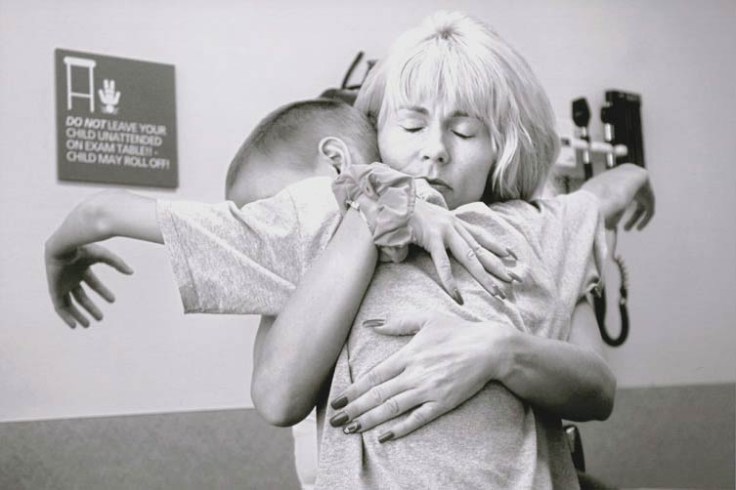
Cyndie French, embraces her son, Derek Madsen, 10, on July 25, 2005, after learning Derek needs surgery to remove a cancerous tumor in his abdomen. The emotional impact is taking its toll on her. “How can anyone maintain a nine-to-five job and do this?” she begins to wonder.

This project has won the 2007 Pulitzer Prize for Feature Photography. The Photography Channel helped to make a multimedia piece, including Renee and the motherโ€™s interview.

4
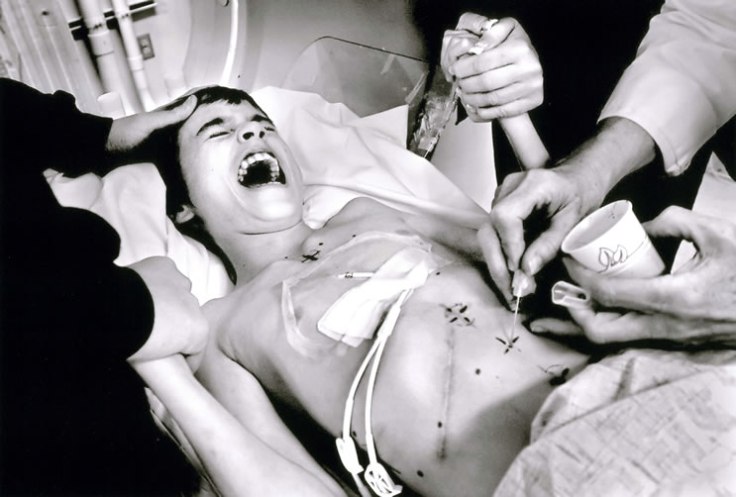
Shortly after his 11th birthday and Cyndie’s 40th, Derek is comforted by his brother Micah Moffe, 17, left, and mom Cyndie, right, as he gets a tattoo in preparation for radiation therapy on November 30, 2005. Micah often accompanies Derek to treatments even though his schoolwork suffers.

Cyndie is a single mother of 5 children, and she quitted her job after Derek was diagnosed a cancerous tumor in his abdomen in 2015 when he was 10. Cyndie tried everything she could to comfort her son.
11
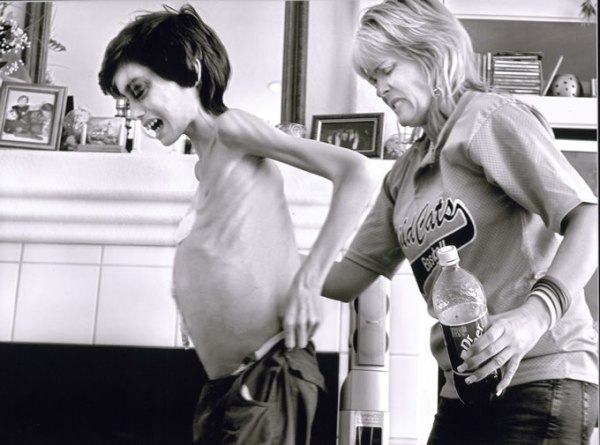
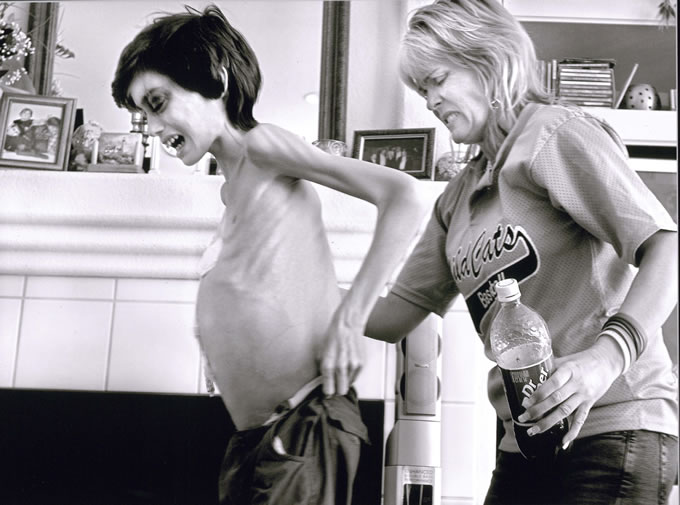
Derek has a final burst of energy after days of Cyndie keeping vigil at his bedside. She helps her anguished son walk on April 26. A cancerous tumor has distended Derek’s stomach so far that his pants no longer fit. Another tumor in his brain impairs his eyesight making navigation difficult inside their rental home.

The interview of Reneeโ€™s is basically her telling stories behind these images, their conversations and their feeling at that time, which strikes a chord with the viewers and amplifies sadness of whoever is watching this.
15
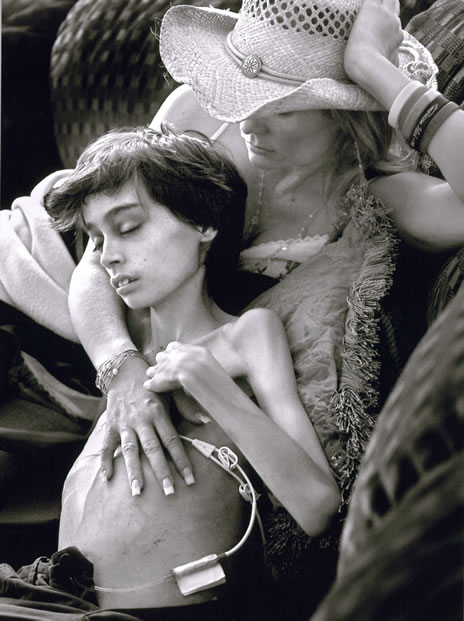
Cyndie holds Derek on May 8. He is on medication that hinders his speech and keeps him awake at night. Except for a few minutes while hospice nurses are with him, Cyndie spends nearly every moment of the day at his side. “I was exhausted beyond belief but I had to do this. He would call my name and always expects me to be there,” Cyndie said.

This is a well established example of multimedia, including interview audios to enhance the impact of still images. It would be better to include interviews of Derek, if he wanted to share his thoughts. From the story telling perspective, I do want to know more conversations or even quarrel between Derek and Cyndie, environment sound in the hospital, etc. But we all know, that this is a heart wrenching story, and we all should show our respect to Derek and Cyndie.

19
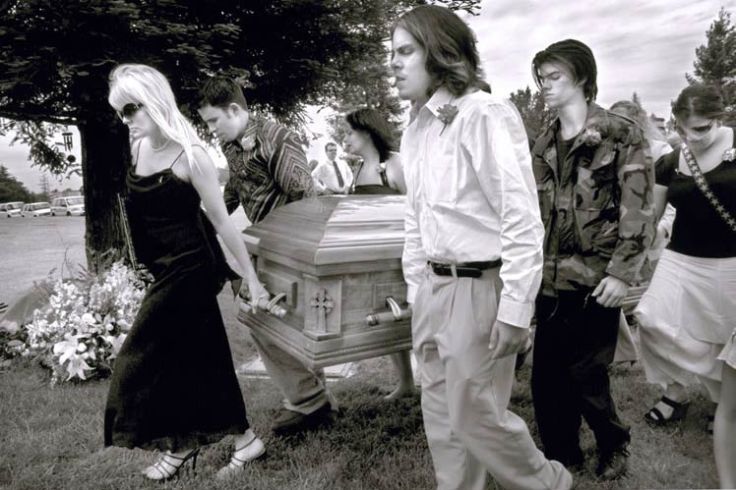
Cyndie leads Derek’s casket to burial with assistance from her sons Anthony Moffe, foreground, Micah Moffe, opposite him, and Vincent Morris, who is not visible, as well as several friends. “I will forever carry your memory in my heart and remind others to give of their time, energy and support to other families like ours,” Cyndie says at the funeral. Derek was buried in Mount Vernon Memorial Park in Fair Oaks, California, on May 19, 2006.


Gestalt Law

Gestalt Law is widely used in spheres like art, design, commercial, photography. It’s all about how our eyes and brain perceiveย a unified shape in a different way to the way they perceive the individual parts of those shapes.

The law can simply be summarized as “the whole is more than the sum of all parts”. For example, take a look at the following picture, some kind of visual games we’ve played since children.

At first, you may see an old coupleโ€™s heads, however when you look even more carefully, you may notice there are two men sitting at the face parts and a woman at the old man’s ear part. This picture shows us how Gestalt Law works, and how our eyes group images as a whole.

There are 4 basic laws of Gestalt: proximity, similarity, continuity and closure.

  • Proximity: close elements tend to be seen as a group or pattern. The smaller an area of space is, the greater possibility it will be perceived as figure (figure-ground relations).

When the little black squares are placed randomly (without proximity), they are perceived as separate images, no particular meaning. However, when you place all little squares together orderly (with proximity), although they are still separate from each other, ย they can be seen as a group, which combines them to a big square.

  • Similarity: similar visual elements(shape, color, size, movement) tend to be seen as related and therefore grouped.

Look at the right image, your brain will automatically process that each horizontal row as a group because they are all black or white (similarity).

  • Continuity: visual elements that require the fewest number of interruptions will be grouped to form continuous straight t or curved lines.

This is a little bit hard to comprehend, but if you look at the following examples, you will understand what is continuity.

The picture on the left, if you see a black dots line like this, guess which red line (โ‘  or โ‘ก) will continue the black one. Most of us will answer line โ‘ก. Why? Becauseย perceiving line โ‘ก as the continuing path would be easier, as we said that it requires the fewest interruptions or changes. The same theory can be applied to the picture on the right. Perceiving an “X” as two straight lines is easier than seeing two arrow marks. The latter requires more visual changes, which our brain doesn’t like very much.

  • Closure: incomplete figures tend to be seen as complete. When a part of a picture is missing, our visual perception will fill in the blank.

ๅฑๅน•ๅฟซ็…ง 0029-09-06 15.47.58

I didn’t find a proper example to show this, but as you can see the WWF logo, there are no lines around the panda’s head. It’s just black and white spots. However we perceive it as a panda anyway.

Another theory about closure is that areas with closed contours are more likely seen than areas with open contour. The batman poster explains a lot.

Okay, we discussed theย Gestalt Law and some cases. The law is actually used wildly in our daily life than you can imagine, such as some famous company logos.


Composition Tips from Steve McCurry

Steve McCurry has been an icon in contemporary photography, as a National Geographic Magazine photographer.

After graduating from Pennsylvania State University, he got employed by a local newspaper The Daily Collegian, where he started his career as a professional photojournalist. After several years domestic experiences in photoj, he left for India to freelance. Then he boosted his career there, as a freelance. He is best known for his 1984 work, “Afghan Girl“.

Steve McCurry, 1984, National Geographic Magazine

The 12-year-old girl Sharbat Gula, was studying in a refugee camp on the border of Afghanistan and Pakistan when this photograph was taken. Her parents were both killed in an Afghan village during an air attack by Soviet.

People always associate this picture with Leonardo da Vinciโ€™s masterpiece Mona Lisa, because of her unfathomable eyes. Her eyes conceal tremendous sadness but at the same time you can read courage and determination. The contrast between her crystal clear eyes and slightly dusty face and her worn-out clothes, shows her sufferings and strengths.

What is important to my work is the individual picture. I photograph stories on assignment, and of course they have to be put together coherently. But what matters most is that each picture stands on its own, with its own place and feeling.

Humanity is always what he seeks for. Depicting profound stories out of ordinary people is the assignment for each photojournalist. But beyond that, Steve has taught us how to utilize composition to be a good photographer.

Here are some composition tips to shoot gorgeous pics.

  • Rule of Thirds

The guideline proposes that an image should be divided into nine equal parts by two equally spaced horizontal lines and two equally spaced vertical lines, and that important compositional elements should be placed along these lines or their intersections.

intersection points
Place important elements along the lines
  • Leading Lines (Radii/Diagonals)

Use natural lines to lead the eye into the picture. It usually starts at the bottom of the frame then lead the eye upwards and inwards. You can easily find a leading line from roads, walls, railways, etc. It generates a feeling of motion, and the lines often meet each other in a vanishing point.

Railway leading lines
Vanishing point
  • Natural Framing

A natural frame can direct the viewer’s eye to what you want to show, also can add depth and dimension to your picture. You can use windows, doors, anything as a frame.

Each window frame tells a story
Use natural circles and squares
  • Patterns/Repetition

Patterns can emphasize your subject and show the size and scale. It’ll also bring impact to the viewers. Patterns can be found in flowers, grocery store, basically it exits in your daily life. But breaking the pattern will enhance graphically appealing.

Monks with the same clothes show great pattern
Use contrasting colors or different size to break the pattern
  • Symmetry

Symmetry is pleasing to the eye because it shows perfect balance of an image. And visual balance brings a certain stability and harmony.

Move your legs to find the symmetry point

Above are just a few tips to improve your works, there are more rules like texture, scale, contrast, light, angle, layer, decisive moment… etc. As Steve puts it, enjoy yourself and photograph in your own way and your own style.

If you’re interested in photography, go out and practice as much as you can.ย That’s the most important rule.

Website Powered by WordPress.com.

Up ↑

Design a site like this with WordPress.com
Get started