
Gestalt Law is widely used in spheres like art, design, commercial, photography. It’s all about how our eyes and brain perceive a unified shape in a different way to the way they perceive the individual parts of those shapes.
The law can simply be summarized as “the whole is more than the sum of all parts”. For example, take a look at the following picture, some kind of visual games we’ve played since children.

At first, you may see an old couple’s heads, however when you look even more carefully, you may notice there are two men sitting at the face parts and a woman at the old man’s ear part. This picture shows us how Gestalt Law works, and how our eyes group images as a whole.
There are 4 basic laws of Gestalt: proximity, similarity, continuity and closure.
- Proximity: close elements tend to be seen as a group or pattern. The smaller an area of space is, the greater possibility it will be perceived as figure (figure-ground relations).

 When the little black squares are placed randomly (without proximity), they are perceived as separate images, no particular meaning. However, when you place all little squares together orderly (with proximity), although they are still separate from each other, they can be seen as a group, which combines them to a big square.
- Similarity: similar visual elements(shape, color, size, movement) tend to be seen as related and therefore grouped.

Look at the right image, your brain will automatically process that each horizontal row as a group because they are all black or white (similarity).
- Continuity: visual elements that require the fewest number of interruptions will be grouped to form continuous straight t or curved lines.
This is a little bit hard to comprehend, but if you look at the following examples, you will understand what is continuity.

The picture on the left, if you see a black dots line like this, guess which red line (① or ②) will continue the black one. Most of us will answer line ②. Why? Because perceiving line ② as the continuing path would be easier, as we said that it requires the fewest interruptions or changes. The same theory can be applied to the picture on the right. Perceiving an “X” as two straight lines is easier than seeing two arrow marks. The latter requires more visual changes, which our brain doesn’t like very much.
- Closure: incomplete figures tend to be seen as complete. When a part of a picture is missing, our visual perception will fill in the blank.

I didn’t find a proper example to show this, but as you can see the WWF logo, there are no lines around the panda’s head. It’s just black and white spots. However we perceive it as a panda anyway.
Another theory about closure is that areas with closed contours are more likely seen than areas with open contour. The batman poster explains a lot.

Okay, we discussed the Gestalt Law and some cases. The law is actually used wildly in our daily life than you can imagine, such as some famous company logos.








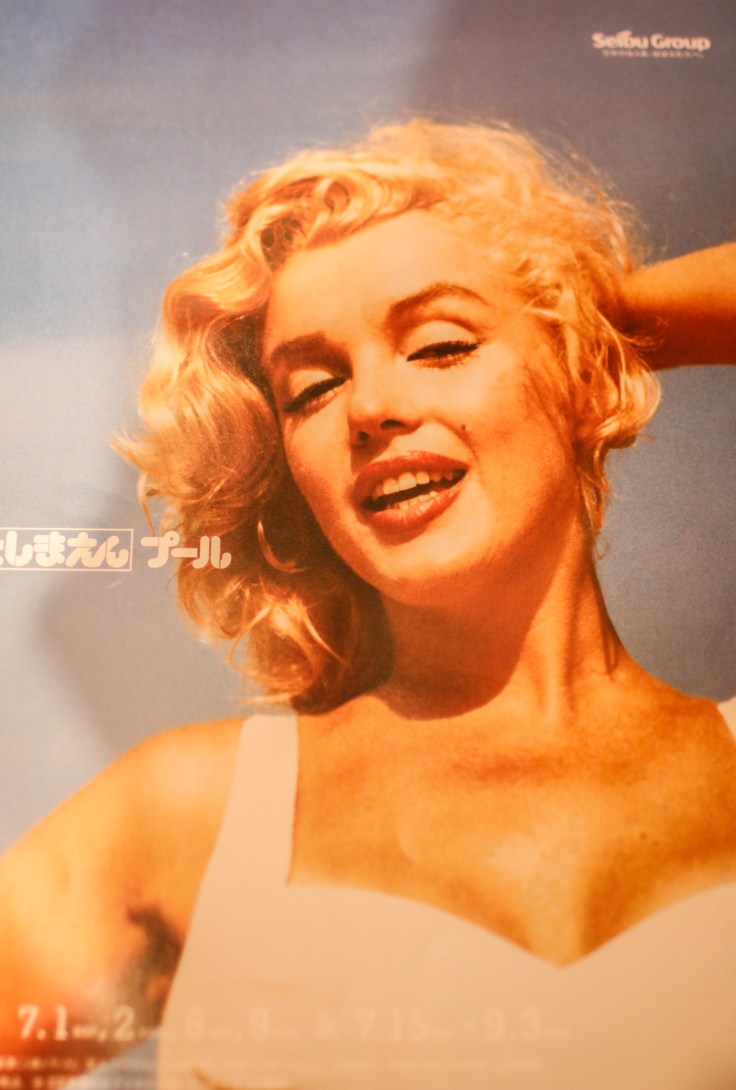
 店に入ると、すぐ壁に飾ってある女優マリリン・モンローの写真が目に入る。モンローが大好きだという。左の棚になんと、全部モンローのポスターだ。(チラシ一枚いただきました。)
 常連さんも多くて、いつも和気藹々な雰囲気で挨拶を交わしている。
 加藤さんの最強ランキングtop5。石原ちゃんが見事に一位に輝いた。僕の一位は桐谷美玲ちゃんだけどね。
 いつも不機嫌に見えるけど、実はすごく面白くて心優しいお爺ちゃんです!ぜひ、「加藤青果商店」に一度足を運んでください。素敵な店です。








 xin mengchen